Mutation Detection Software for Sanger Sequencing
CodonCode Aligner includes powerful mutation detection tools for Sanger sequencing, enabling the detection and analysis of heterozygous point mutations and heterozygous insertions and deletions:
- Calling secondary peaks in sequence traces
- Highly sensitive SNP detection by analyzing aligned traces in contigs
- Multiple methods for analyzing sequence traces with heterozygous insertions or deletions (indels)
For heterozygous point mutations, CodonCode Aligner analyzes traces for the presence of both a secondary peak and the reduction in intensity of the primary peak. This approach is (a) more sensitive and (b) less likely to yield false positive results than simpler approaches that analyze only secondary peaks.
CodonCode Aligner can use open reading frame annotation from reference sequences to give amino-acid level annotation of the effect of point mutations:
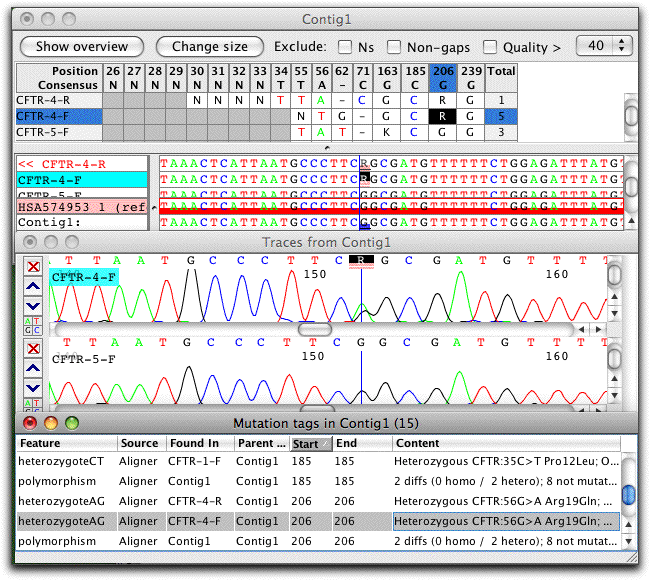
Since all automated methods to identify heterozygous SNPs can produce erroneous results, manual verification of mutations is often required. CodonCode Aligner lets the user quickly confirm or reject any SNPs that were identified by automatic detection by using buttons in the customizable toolbar, keyboard shortcuts, or menu items.
Manual confirmations are shown as a checkmark in the trace views, and labeled as "Confirmed" in the mutation result tables. An example is shown in the screenshot on the right for the CFTR-5-R sequence trace.

Heterozygous Indel Analysis
CodonCode Aligner also provides several methods for the detection and analysis of heterozygous insertions and deletions. Here is an example of sample with a heterozygous two-base deletion that was separated into two pseudo-alleles with CodonCode Aligner's "Split Heterozygous Indels" option:
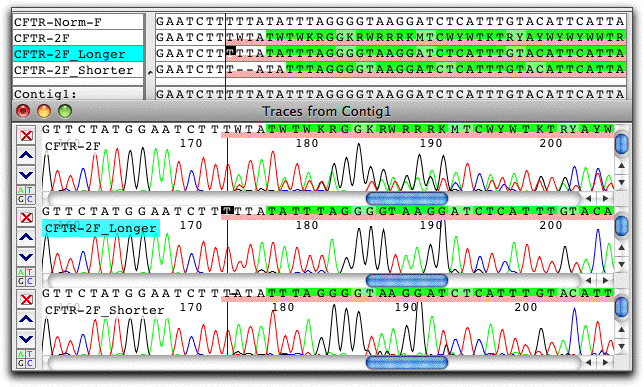
The "shorter" pseudo-allele trace created by CodonCode Aligner clearly shows the deletion of two Ts.In addition to the splitting method shown above which does not require any additional information beside the sequence chromatogram, CodonCode Aligner offers two additional methods to analyze heterozygous indels within the contect of contigs.

Tutorials and How-To Guides
📚 Learning Center: Using CodonCode Aligner
🎬 Video Tutorial: Mutation Detection in CodonCode Aligner
🛠️ How-To: Detect Mutations with CodonCode Aligner
⚙️ Fine-Tuning: Mutation Detection Settings
🔬 In Depth: Mutation Detection Algorithms
🎬 Video Tutorial: Heterozygous Indel Analysis
🛠️ How-To: Analyze Heterozygous Indels
Trusted by Researchers Worldwide for Mutation Detection
CodonCode Aligner has been cited in hundreds of scientific publications as reliable mutation detection software for Sanger sequencing. Researchers across disciplines - from genetic disease studies to microbial identification and phylogenetics - rely on its accuracy and ease of use. Below is a selection of peer-reviewed studies that used CodonCode Aligner for detecting and analyzing mutations.
-
Identification of a Novel Homozygous Mutation in BBS10 Gene
in an Iranian Family with Bardet-Biedl Syndrome
M. Dehani et al.
Avicenna J Med Biotechnol 13, 230–233 (2021) -
Genetic evidence for predisposition to acute leukemias due
to a missense mutation (p.Ser518Arg) in ZAP70 kinase: a case-control study.
Khashei Varnamkhasti, K., Khashei Varnamkhasti, S., Shahrouzian, A. et al.
BMC Med Genomics 17, 200 (2024)- Spontaneous miscarriage driven by maternal genetic mutation at position of PAI-1-844G/A: shed light on a race-specific genetic polymorphism.
Ameri, A., Khashei Varnamkhasti, K., Parhoudeh, S. et al.
BMC Res Notes 16, 360 (2023)- Thyroid Cancer-Associated Mitochondrial DNA Mutation G3842A Promotes Tumorigenicity via ROS-Mediated ERK1/2 Activation
Chen, S., Bao, X., Chen, H. et al.
Oxidative Medicine and Cellular Longevity (2022)- A Pilot Study on BRCA1/2 and PI3K Mutations Across Subtypes of Triple Negative Breast Cancer in North Indian Population
Gupta, P., Thakur, T., Chadda, A. et al.
Applied Immunohistochemistry & Molecular Morphology 32, 462-468 (2024)- Biallelic NDUFA4 Deletion Causes Mitochondrial Complex IV Deficiency in a Patient with Leigh Syndrome
Misceo D., Strømme, P., Bitarafan, F. et al.
Genes 15, 500 (2024)- Model-Based Analyses Suggest Pleistocene Refugia over Ancient Divergence as Main Diversification Driver for a Neotropical Open-Habitat Treefrog
Brusquetti, F., Pupin, N.C. & Haddad, C.F.B.
Evol Biol 50, 432–446 (2023).- ALK-Negative Anaplastic Large Cell Lymphoma (ALCL): Prognostic Implications of Molecular Subtyping and JAK-STAT Pathway
Parkhi, M., Bal, A., Das, A. et al.
Applied Immunohistochemistry & Molecular Morphology 29, 648-656 (2021)- A comprehensive study of mutation and phenotypic heterogeneity of childhood mitochondrial leukodystrophies
Hosseinpour, S., Razmara, E., Heidari, M. et al.
Brain and Development 46, 167-179 (2024)- A novel frameshift variant in the TMPRSS3 gene causes nonsyndromic hearing loss in a consanguineous family
Rezaie, N., Ghazanfari, S., Mousavikia, S. et al.
BMC Medical Genomics 17 (2024)- Loss of Nexilin function leads to a recessive lethal fetal cardiomyopathy characterized by cardiomegaly and endocardial fibroelastosis
Johansson, J., Frykholm,C., Ericson, K. et al.
American Journal of Medical Genetics Part A (2022)- Characteristics of DNMT3a mutation in acute myeloid leukemia and its prognostic implication
Khattab, A.M.T., Ghaffar, A.A.A.A., El-Sewefy, D.A. et al.
Egypt J Med Hum Genet 25, 97 (2024)- Novel somatic mutations of PIK3CA in patients with colorectal cancer
Vatte, C., Cyrus, C., Chathoth, S. et al.
World Academy of Sciences Journal (2025)- A frame-shift mutation in COMTD1 is associated with impaired pheomelanin pigmentation in chicken
Bi, H., Tranell, J., Harper, D. et al.
PLOS Genetics (2023)- Targeted gene sequencing of FYCO1 identified a novel mutation in a Pakistani family for autosomal recessive congenital cataract
Saleem, R.S., Siddiqui, S.N., Irshad, S. et al.
Molecular Genetics & Genomic Medicine (2022) - Spontaneous miscarriage driven by maternal genetic mutation at position of PAI-1-844G/A: shed light on a race-specific genetic polymorphism.